
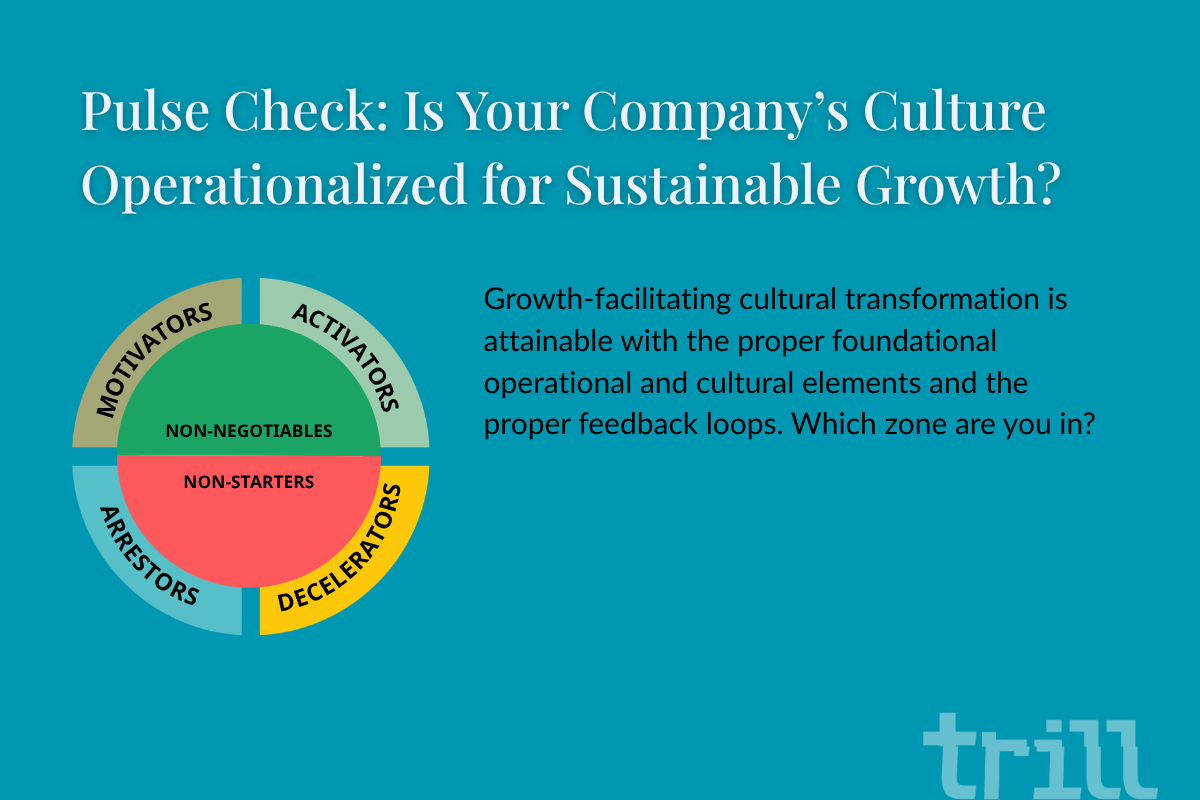
We’ve all heard that cultures eat strategies for lunch, but are we taking this maxim seriously?
For this month’s small bite, here’s a handy matrix you can use to take a quick organizational pulse check, served with a side of leadership theory. This hits.
On the continuum from Arrestors to Activators, organizational moxy is characterized by some very important tells, and there are actionable steps you can take at any zone of cultural maturity to ensure your company culture is both 1. optimized for growth and 2. operationalized for sustainable growth.
If you’re not taking care of your people first (this includes proper organizational capacity and resourcing as well as diversity, team cohesiveness and cross-functional collaboration), then how will you ever attend to your customer base as you scale? Likewise, if your organization is encumbered by departmental infighting and bureaucracy or lacks the proper organizational alignment and the foundational success levers to care for your customers, then operationalizing long-term sustainable growth isn’t a realistic aim.
Scaling an organization is a precise dance between operations and culture and growth is an inside job. Neglect either pillar and so goes the organization’s growth: stuck, stagnant, or stale.
Excellent companies have followed these steps over time to operationalize sustainable growth:
- They have removed obstacles and barriers to growth (Arrestors & Decelerators)
- They have implemented the operational and cultural pillars that facilitate growth (Motivators & Activators)
- They leverage feedback loops to maintain their Activator position of operationalized sustainable growth (Think balanced scorecard assessment of operational and cultural KPI’s).
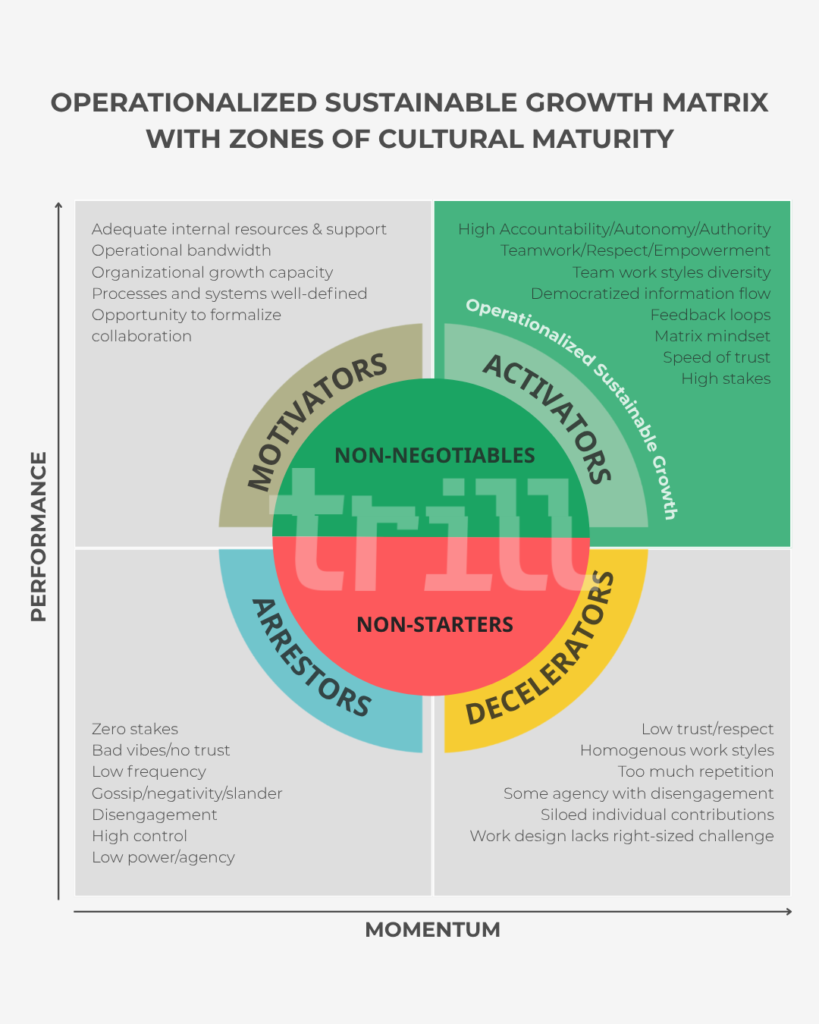
No matter where you fall within the zones of cultural maturity, you can use this matrix to help assess and to help triage your current cultural zone. Should you find yourself in red among the Arrestors and Decelerators, with some smart pivots and small shifts, cultural transformation doesn’t have to be a long-run play; short-term course corrections are possible and achievable; and with transparency, visibility and regular review cycles for operational and cultural KPI’s, operationalized sustainable growth delivers strong returns, by design.
Some Extras to Help Shape Your Action Plan at Every Zone
Arrestors (Stuck): Disincentives including and up to PIP and termination for failure to embody and uphold cultural excellence. You have to cut the gossip and apathy off at the source so it doesn’t catch like wildfire and block growth. Make sure your organization’s mission and values are clear and known to all employees and ensure that all employees are measured in their annual reviews by their effectiveness at upholding these values. Bonus if you include a 360 degree peer review component.
Decelerators (Stagnant): Where monotony and lack of agency proliferate, performance stagnates. Here, the best employees maintain bare-minimum effort until they can secure an offer from another company, and the coast-and-punch-disengaged can become aimless and lose passion. Cross-training, personal development, growth plans and coaching, fostering a culture of teamwork and collaboration by rewarding team wins, and incentives offered for effectively challenging the status quo with a smarter, more efficient, or more collaborative approach can all be helpful to lifting culture out of the red zone towards one that actually scales growth: just make sure these actions anchor to your organization’s mission and values. Bonus if all employees can name your organization’s mission in 4 words you’ve defined for them.
Motivators (Stale): Things run smoothly in this zone, but we’re tracking excellence by introducing more challenge and higher stakes for top performers. Teams are resourced well. Processes are well defined. The right systems are in place. Here, leadership needs to delegate more and to take a more integrative and collaborative approach to problem solving. This means soliciting feedback from all levels of the organization with employee engagement surveys and informal all-hands meetings where it’s safe to ask challenging questions and to give candid feedback. The organization at this stage needs to move from a hierarchical leadership structure towards matrix management; the hierarchy that built process and efficiency now has to become malleable for rapid iteration and high empowerment. Top performers are given bigger challenges and higher stakes, and incentives are established to celebrate team wins and to recognize exceptional individual contributions.
Activators (Secure): This is where the magic happens. You have the right people, processes and technology working seamlessly together in a management matrix wherein senior leadership sets the goals and direction in a culture of high accountability and high empowerment. It’s not that there isn’t some hierarchy, but it’s flatter in this zone. Work design is collaborative, flexible and adaptive. Employees are A-players with high personal accountability who can rapidly iterate new approaches and quickly respond to the changing demands of the market. Teams are agile, diverse and trustworthy. Customers receive excellent care because the internal culture is optimized for employee engagement and therefore growth is inevitable, but it must also be protected by feedback loops such as quarterly and annual employee engagement surveys to identify cultural, leadership or process pitfalls ahead of the curve so they can be remediated before they hit the customer base downstream. Even with a mature and operationalized growth strategy, feedback loops are pivotal to maintaining your growth position. This zone is secure, but only if you don’t rest on the laurels of past successes.
In conclusion, your company’s culture greatly shapes your ability to operationalize sustainable growth. By utilizing the defined operational and cultural levers to operationalize sustainable growth, momentum and performance can be maintained and even accelerated within a mature, Activator organization.
Disclaimer and indemnification: The above framework is fully theoretical and based entirely on my personal experiences navigating each zone of cultural maturity within a diverse set of organizations (various sizes, roles and industries) over my career of 20+ years. This is offered as a guide, not a panacea. Implement what fits. Discard what doesn’t.
Leave a Reply