
Life is either a daring adventure, or nothing. -Helen Keller
This month’s newsletter is about cultivating deeper relational awareness and connection, and the duo of charts you’ll find below forms a relational portmanteau (French for “bring what you need”), but not without some personal effort and application! Let’s go!
The 3R’s, Defined
If you’ve been around leadership theory for a while, you’ve heard about the 3R’s: Retribution, Reciprocity and Reason.
While the 3R’s are taught academically, they also appear as relational styles in daily life at work and at home, and while individuals often gravitate most towards one of the three styles, you can use them all and you probably should.
Retribution is a leadership style that focuses on consequences for failure to perform to standard. Reciprocity says I’ll do/I did x if you’ll do y. Reason appeals to the deeper purpose of the work and the why behind the what.
As leaders, how you deliver your appeal for results vis-à-vis the 3R’s matters a lot: Context first. Then application.
A Case Study in Applying the 3R’s
Sofia is angry that her direct report, Steve, is approaching a deadline and hasn’t begun work on his deliverable for a highly visible project. A savvy leader holds the muscle of Retribution gently and seeks first to understand the reasons Steve’s work has been delayed (context) and delivers the ask (application) by tailoring it to Steve’s personal style (context) in a way that lands best (application). Knowing which of the 3R’s to use within what measure is a bona fide superpower of relational awareness that you can cultivate.
Sofia has been less accessible for meetings and check-ins during this month’s travel, but Steve needs more clarity and collaboration to complete the deliverable. Entry level in his career, but reliable and driven, Steve doesn’t know how to ask for the support that he needs without sounding off-putting. Steve’s concerns are as valid as Sofia’s here, and this is where it’s so important to understand the 3R’s and to wield them both softly and within context.
How Sofia handles the situation of a potential missed deadline can make or break Steve’s morale, compromise team success, create a bad look for the team, and I could go on but you get the point…… Leaders set the tone!
Going in guns blazing with Retribution given the context is a surefire path to all of the poor outcomes that we want to avoid! Steve needs collaboration and partnership. Reciprocity is an outstanding intermediate path to getting the deliverable back on track and completed ahead of schedule wherein work is divided justly and support is offered; Reason, however, is going to earn Steve’s highest engagement, effort and results. Reason, also known as the professional application of wisdom, seeks more to understand (why is this behind?) than to be understood (why didn’t you start this yet?) You can feel the difference.
Empowered with the knowledge that Steve needed help getting in touch with Sofia during her international travel and limited windows to connect, Sofia sets a 30 minute touch base to offer support and to genuinely understand Steve’s questions and obstacles to completing the work. Because she creates a container for connection dedicated to this project, Steve gets the clarity he is seeking, and because he doesn’t feel rushed, Steve feels more comfortable asking the questions he needs to ask in order to complete the deliverable. Sofia is able to offer some coaching and support and take on small tasks towards completing the deliverable if needed, but mostly, by being accessible and fully present, Sofia has cultivated a leadership tone of high trust and high empowerment so that Steve can sail smoothly and complete the goal ahead of schedule in full alignment with Sofia’s expectations. Steve grows in experience and confidence and he is now more engaged, experiences higher job satisfaction and continues to up-level his contributions to the company.
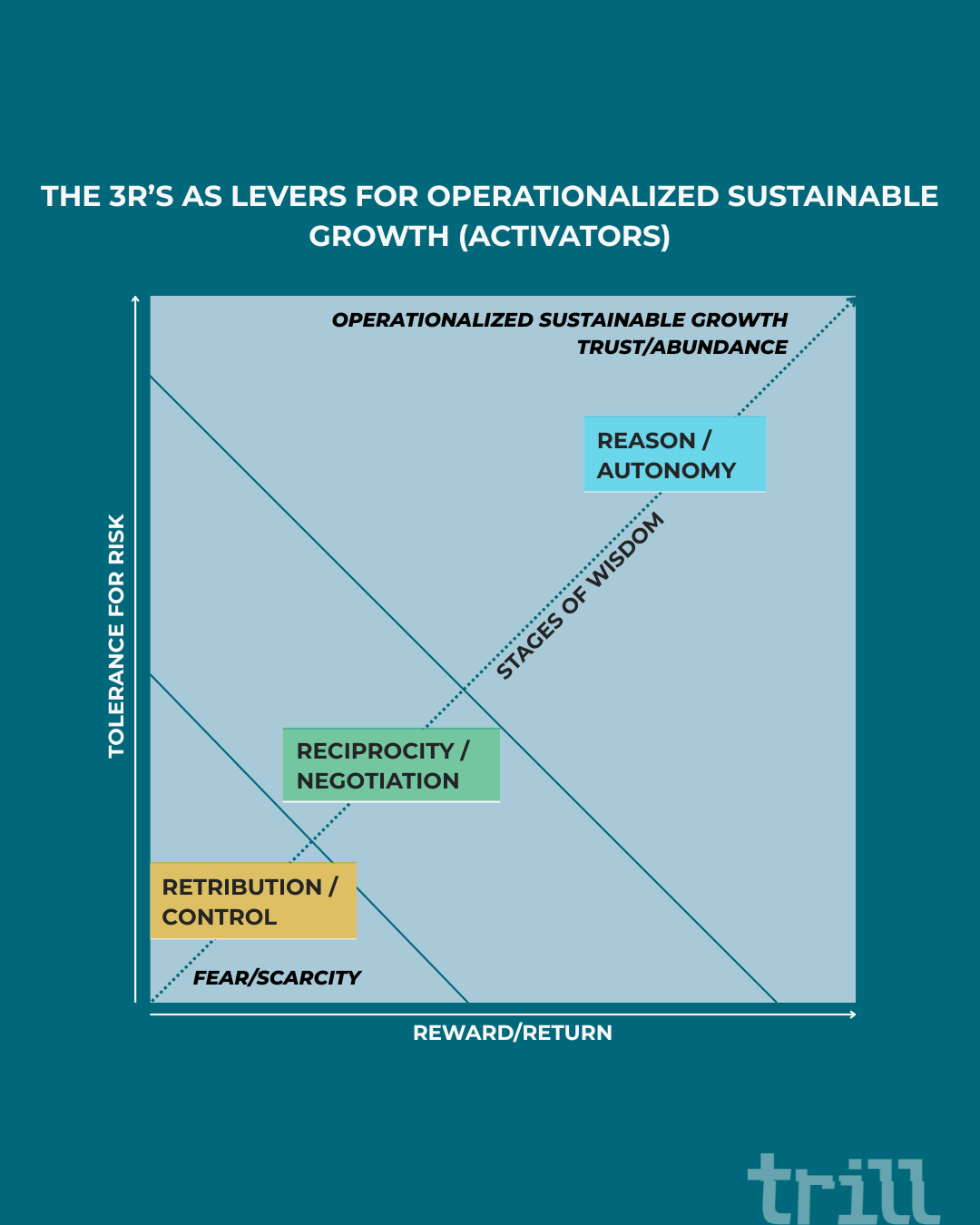
On the organizational growth continuum, we move from fear/scarcity to trust/abundance through the stages of wisdom.
Managers get results – and sometimes frazzled employees who resent their jobs.
Leaders build cultures that operationalize sustainable growth.
Operationalized sustainable growth catalyzes longevity and win-win outcomes.
Are you leading with empathy and context (Reason) or the formidable tyranny of the urgent (Retribution+ reactivity without context)?
Are you more yin/yang Reciprocity and if so, what could you delegate with Reason to build higher stakes engagement within your team?
Most importantly, what support do your employees need in the moment? Some seasons call for in the trenches Reciprocity, or even Retribution if performance issues are ongoing without resolution, yet Reasonis by far the leadership lever that builds other leaders and multiplies organizational leadership.
The highest caliber leaders in your organization are most certainly flexing their Reason muscles and maximizing their output accordingly through right-sized challenge, high stakes empowerment and effective delegation.
A Note About Meeting Emerging Leaders and Mature Leaders Where They Are At
Some managers feel more comfortable in lower stages of wisdom. Meet them there. Plant the seeds. Save yourself the time and the headache of attempting to pull anyone up to the higher planes of wisdom when they aren’t ready for it yet – if someone isn’t operating from that plane, it’s just not going to land. Some people respond perfectly well to Reciprocity or Retribution because it’s their preferred leadership style and what feels most comfortable or familiar. At the end of the day not all employees are leaders, but cultivating a culture of organizational leadership is still important: The employees who get it will lean in and respond to appeals of Reason.
In conclusion, be pragmatic and relevant in your application of the 3R’s; stick to what works and what people are ready for; and don’t force the rest. I promise this M.O. works in your personal life as well as in the workplace. Don’t add friction when you can meet people where they are at. Be contextually clear. Model the up-level anyway.
Bonus Content: How to Cultivate Aligned Adult Friendships (Because We’re Not Singularly Organizational Cogs After All and It’s Lonely at the Top)
This is a short and sweet exercise that will change your life if you put in the effort. Just as we manage to what we measure, we cultivate more aligned adult friendships by first defining a few interests and goals.
No, you don’t have to speed network, go to a bar, or embarrass yourself to do this exercise, and you can do it in minutes from the comfort of your own home or office.
We’ll begin with my personal favorite chart, the Venn diagram.
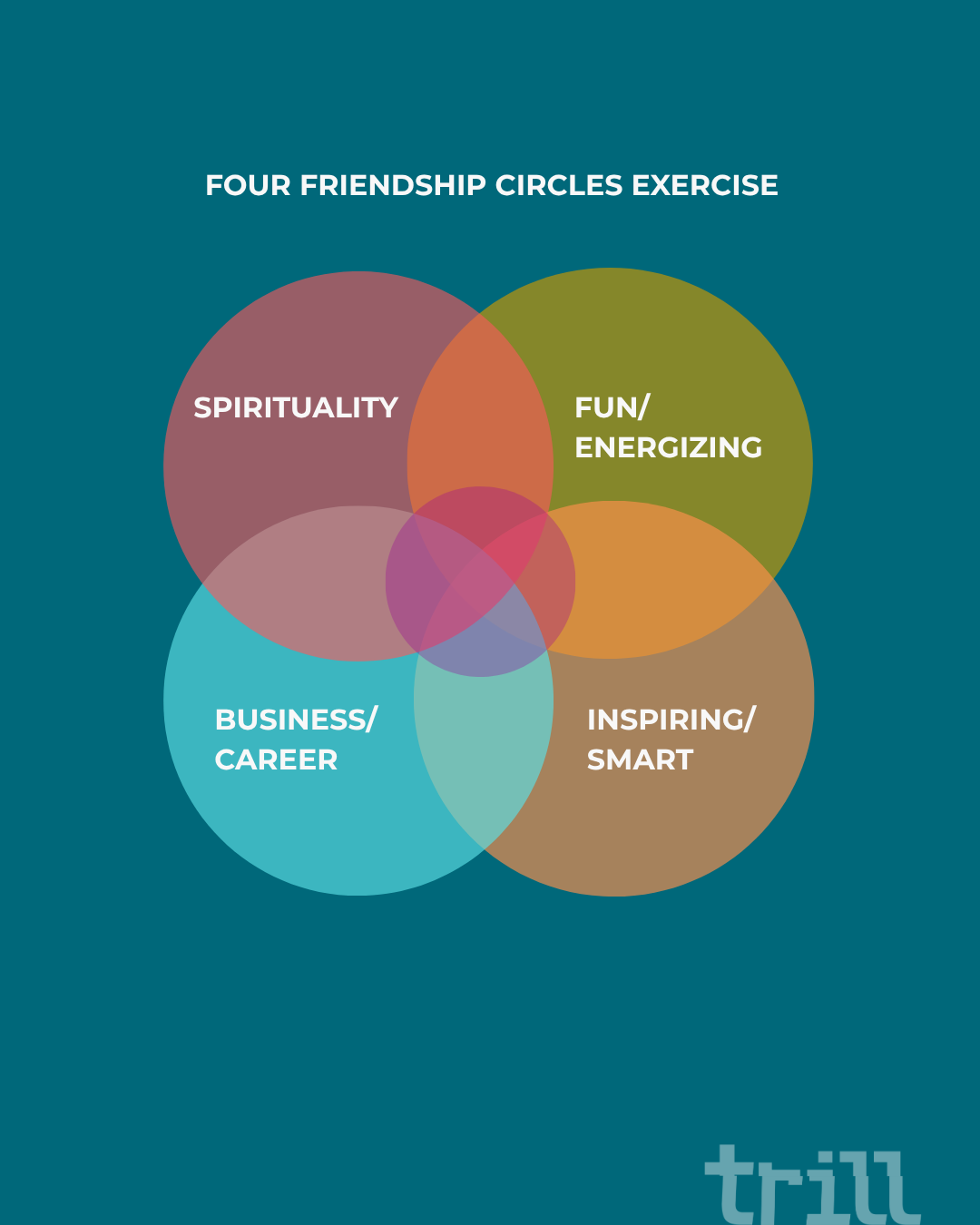
Draw four circles. I did it on paper but you might choose to use the template I posted to my LinkedIn profile for this because, I don’t know about you, but I lost my geometry compass a long time ago.
I’ll leave it to you how you create your circles. Just make sure they each intersect and that you reserve one spot in the middle where all four circles connect. Here are my four circles as a guide (please adapt to what you value!)
Some Questions To Help You Get Started
What do I value most in life? Consider individual interests. How you spend your time. Activities you do in your personal time and with friends. Think about which friendships light you up and make you feel alive, seen, heard or excited about life.
Consider any gaps you have in your friendships and any roles in friendship that could be contributing to these these gaps – e.g. stages of life (raising children, empty nester, working or retired), types or work, and availability for connection.
Empowered from some focused reflection, it’s time to select your four friendship values and assign one value to each circle. Once you’ve picked your four circles, you’ll notice areas where spheres of values overlap in one or multiple intersects.
Let’s Plot
Begin plotting the friendships you already have in the areas where circles intersect. Maybe you are one part career circle and one part spiritual circle – which friends do you have already that share those values with you? These are solid friendships, but perhaps due to seasons of life stages or personal matters you aren’t able to connect with these friends as often as you’d like. That’s okay – keep going and keep plotting which friends fall into each overlap of the circles. You are taking inventory of your current friendship landscape to accomplish three goals:
- Map your current friendships to provide context and information for how you are feeling about the current state of your friendships
- Be able to not only pinpoint, but also see in a visually compelling way, why you may be feeling unfulfilled/unseen/lost in navigating your adult friendships
- Make a very concrete but simple plan to find and to cultivate more aligned adult friendships that bring you true connection and multiply your joy
As stated when we began, it can be challenging to put feelings into words and strategies unless you can ascribe some context and better understand the status quo, and this exercise forces radical clarity about which friendships you need to cultivate, or stated another way, who you should really be spending your time with!
Life is too short to spend time on friendships that drain us or leave us feeling unfulfilled or unseen, and given the myriad demands on our adult schedules, you owe it to yourself to cultivate friendships that help you to feel good about yourself and about growing together on the journey that is life! This is your moment to take an audit; to cultivate deeper friendships with the tribe that brings you joy; and to cut out what isn’t working so you can free up more time and space for the friendships that truly fill your cup.
Cultivating adult friendships is a lifelong endeavor. Hopefully, from this exercise, you were able to identify one or a few high quality friendships that you should grow and expand. You may have even identified acquaintances who share all four of your friendship values to invest more deeply in. You may also find, even with a few friendship wins, that you’re coming up short on the kind of mutual exchange and common thread friendships you’d like to build, and that’s okay! Awareness is the first step, then defining some concrete and actionable steps. The Universe loves clarity, and you will immediately become more magnetic and begin attracting more aligned adult friendships simply by defining what you’d like more of and what you need to limit (If you did this exercise, cheers! You’re so much closer already!) Woo aside, definition and desire are truly the first steps to manifesting any lasting and meaningful changes in any area of your life!
Footnote
The Four Friendship Circles were born during a time in my life when I was navigating a dark season of depression in which I was work-functional and crushing my career, but wherein I spent far too many evenings after work sad and in tears, and I realized I had to get to work on changing my life starting with some community, stat! This really works, and for me, it was the beginning of a whole new beautiful life of thriving and finding joy – even in the hard things! No matter what your transformation looks like on the flip side of the Four Friendship Circles Exercise, I can personally guarantee that the effort you put into this really does yield. Chin up, you’ve got this!
Leave a Reply